Unfamous Places recommends
The Albanian Alps. Bješkët e Namuna — the Accursed Mountains. Bears in the forests. Rivers the colour of glacier melt. A ferry journey described as the most beautiful in Europe. Almost no tourists.
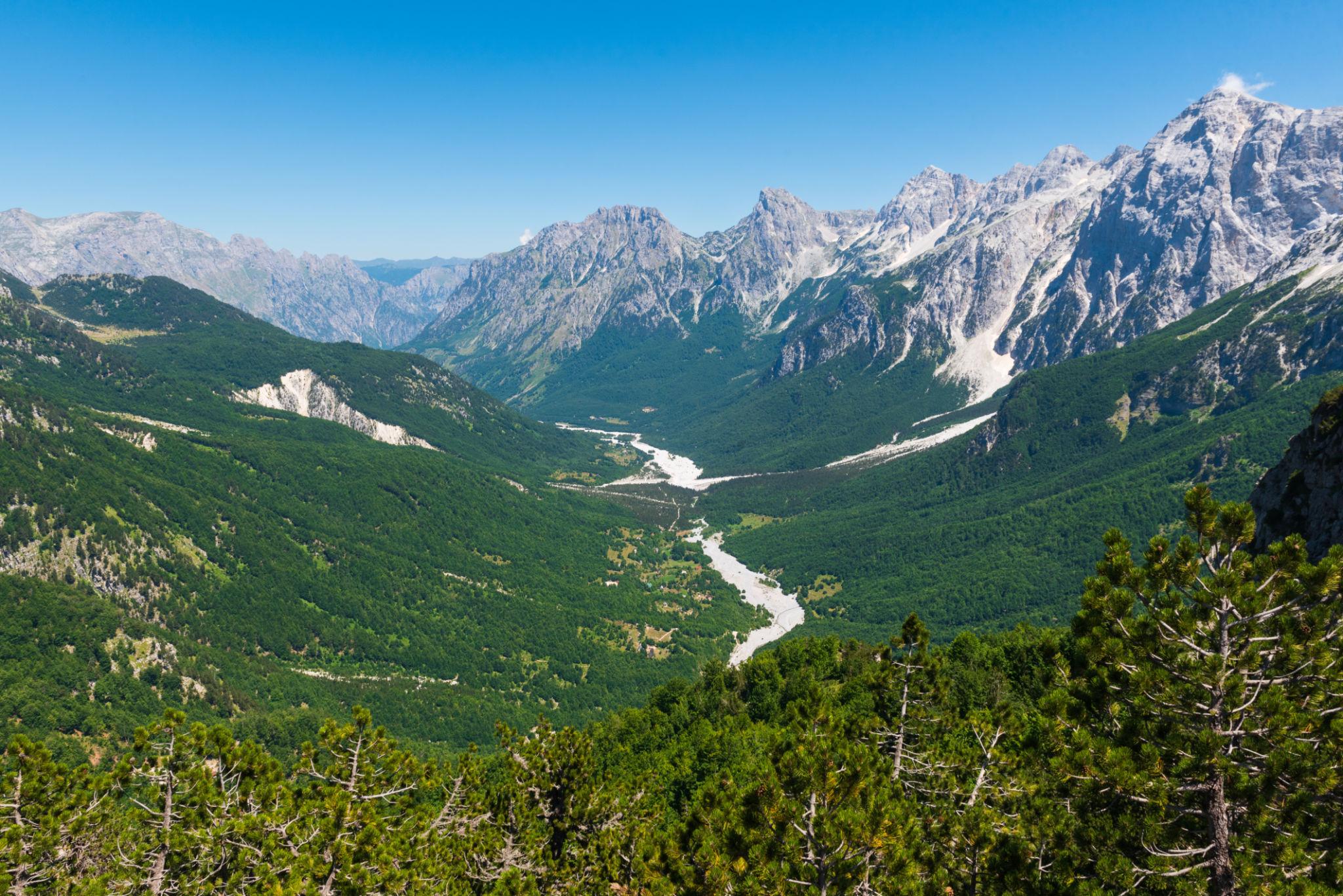
The Albanian Alps — Bješkët e Namuna, the Accursed Mountains — are named from an Albanian legend: a mountain faerie cursed the peaks after her stone was accidentally moved. The name is apt. These are mountains that kept foreign armies out for centuries, that maintained the ancient Kanun code of honour and hospitality into the 20th century, and that were effectively closed to outsiders until after 1990. Wolves, bears, and lynx still live in the forests. The rivers run turquoise from glacial melt. This is not the Dolomites with better signage. This is genuinely different.
The three-hour ferry from Koman to Fierëz passes through a fjord-like canyon of the Drin River: steep limestone cliffs dropping directly to the water, dense forest above, tiny isolated farms and hamlets clinging to the slopes, and water the colour of turquoise glass. There is no road along this stretch — the ferry is the only way through. It is consistently described by the travellers who do it as one of the most beautiful boat journeys in Europe. Most people have never heard of it. Book the morning departure, take the upper deck, and bring a jacket.
Theth is a scattered village of stone houses and a small 19th-century church in a valley ringed by 2,000-metre peaks, accessible by a paved mountain road from Shkodra. Valbona is broader, wilder, the Valbona River running vivid turquoise alongside the single track road. The hike between them — 15 kilometres over the mountain pass — is one of the finest day walks in the Balkans: six hours through beech forest and limestone karst, with the valley visible on both sides from the top. You will be one of very few people on it who did not grow up in Albania.
The Kanun of Lekë Dukagjini — the ancient Albanian customary law codified in the 15th century — included a provision that the guest was inviolable: a host was obliged to provide protection, food, and shelter to any traveller who arrived at the door, even an enemy. That tradition of extraordinary hospitality survived the Ottoman occupation, Communism, and the isolation of the Hoxha years, and it is still felt in the guesthouses of the north. You will not go hungry. You will not be made to feel unwelcome. The food will be homemade and it will be extraordinary.
Northern Albania works as a circuit. Most visitors allow four to seven days and move between three places: Shkodra, Theth, and Valbona. The route below is the classic sequence and the one we recommend.
The cultural capital of northern Albania — a city of 100,000 people with Rozafa Castle on a hill above the confluence of two rivers, a lively pedestrian street, good hotels, and the Marubi National Museum of Photography (the finest photography collection in the western Balkans). The base from which to organise transport into the mountains. Spend one night; two if you want to explore properly.
A scattered stone village at 800 metres in a valley ringed by 2,000-metre peaks. The 19th-century church, the Blue Eye glacial pool, the Grunas Waterfall, and the start of the hike to Valbona. Accessible by minibus from Shkodra (2.5 hours) on a road that has been recently paved but is still an experience. Stay at least two nights in a guesthouse. The host will feed you better than anywhere.
The broader, wilder valley to the east — reached by hiking from Theth (the best option, 6 hours) or by a combination of minibus and the Lake Koman ferry (8–9 hours, spectacular). The Valbona River runs turquoise alongside the single track road. The Valbona–Theth hike in reverse is equally good. Return to Shkodra via the Lake Koman ferry if you have not yet taken it. You should take it.
April–May. Snow still on the high passes; the Theth–Valbona hike is not safely crossable until June. Beautiful but restricts mountain access.
The hike opens, the rivers are at full turquoise force, and the very small number of visitors have not yet arrived. The ideal month.
The busiest months — by Albanian mountain standards, which means you will share guesthouses with a handful of other Europeans and considerably more Albanians on holiday.
The hike is still open, the light is golden, and many guesthouses offer better availability. The rivers are lower. A very good time to visit.
Most mountain guesthouses close from October to May. The Theth–Valbona hike is only safely passable from June to September. Do not attempt the high pass in bad weather at any time of year without local guidance.
Direct flights from London, Rome, Vienna, and other European cities on British Airways, Wizz Air, and others. Tirana Airport is 30 kilometres from the city. A bus or taxi to Tirana, then an onward bus to Shkodra (2 hours) or direct minibus from the airport to Shkodra in high season.
Buses run frequently between Tirana North Bus Station and Shkodra (€5–8). A hire car gives maximum flexibility for reaching Theth and Valbona; note that some rental companies restrict cars on unpaved mountain roads — read the small print carefully.
Minibuses from Shkodra to Theth run daily in season (2.5 hours, €8–10). For Valbona via Lake Koman: shuttle to Koman village (1.5 hours), ferry to Fierëz (3 hours), minibus to Valbona (1 hour). Book the ferry seat in advance through Berisha Ferry or Komani Lake Ferry.
Albania drives on the right. Roads in the mountains are narrow, steep, and occasionally dramatic; a small SUV is preferable to a saloon. A hire car is the most flexible option but also requires the most confidence. Most mountain guesthouses can arrange transport for you if you ask in advance — this is usually the simplest approach.
The UNESCO-listed city of a thousand windows — a hillside of Ottoman houses with the citadel above, one of the best-preserved historic towns in the Balkans. Four hours south of Shkodra by road.
The Bay of Kotor is two hours by road from Shkodra across the Albanian-Montenegrin border. A natural combination: northern Albania’s wild mountains followed by Baroque waterfront elegance.
The largest lake in the Balkans, shared between Albania and Montenegro, home to Dalmatian pelicans and ringed by hills. Kayaking and swimming from the Shiroka shore outside Shkodra.
The Rugova Canyon outside Peja in Kosovo is the continuation of the same mountain landscape — and the Visoki Deçani Monastery, 14th-century Serbian Orthodox, is one of the finest medieval buildings in the Balkans. The Theth–Valbona trail connects to Kosovo trails.
A turquoise tributary of the Drin that is best reached by speedboat from the Koman end — a river canyon of extraordinary beauty, almost entirely without visitors. Often combined with the Koman ferry trip. Swimming in the Shala is one of the finest experiences in northern Albania.
The capital — chaotic, colourful, and rapidly developing. The Blloku neighbourhood has some of the best bars and restaurants in the western Balkans. The National History Museum is essential. The mountains make more sense once you have seen where the country has come from.